Story
The Three Thousand Dollar Piece of Paper: What It Costs a Huntsville Family to Prove Their Child Needs Help
2026-09-18 · The Dyslexic Difference
Ask a Huntsville parent how they found out their child was dyslexic and you will often hear a version of the same story. Not a screening. Not a teacher's phone call. A parent who would not let it go.
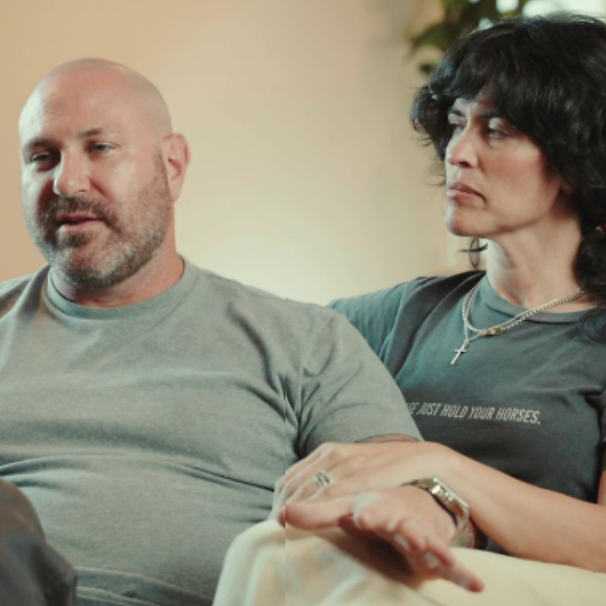
One local couple, both parents to two boys, describe their sons this way: very happy kids, friendly kids, helpful kids, and, in their words, very good at staying under the radar.
That last part is the problem. Their school never raised a concern. The parents were the ones who noticed, at the kitchen table, watching homework.
I could see that their little wheels were spinning, but they couldn't decipher it. You could tell that they were just lost. And it wasn't for a lack of them trying or showing up. They just couldn't get it.
When they brought it to the teachers, they got a question back that stopped them cold.
They asked me, well, do they have a diagnosis? I guess we didn't really think that, oh, we have to have a piece of paper to show you that our kids are struggling.
The kids nobody flags
What makes this interview unusual is that both parents are dyslexic. Both have ADHD. Both built working lives around it before anyone put a name to it.
One of them worked up to site manager.
Numbers, metrics, and all the things. I might have had a hard time with that, but I could get my job done. I figured out different ways to get it done. I didn't have that learning in school. I just had to figure it out.
They describe a habit a lot of undiagnosed adults will recognize:
Out of high school, it's like I've just always tried to overcompensate for where I know that I struggle.
And then the line that reframes the whole interview:
I didn't know that dyslexia and ADHD was hereditary.
Most parents do not. The research is clear on it. A meta-analysis of family-history studies by Snowling and Melby-Lervåg, published in 2016, found that roughly 45 percent of children who have a first-degree relative with dyslexia develop dyslexia themselves, compared with just under 12 percent of children without that family history. Dyslexia and ADHD also travel together: estimates put bidirectional co-occurrence between the two at 25 to 40 percent, according to a 2019 meta-analysis in the Journal of Neurodevelopmental Disorders.
Put plainly, a parent's own dyslexia is one of the strongest predictors available, and it costs nothing to act on. If reading was hard for you, watch your children early and ask the school for dyslexia screening in kindergarten rather than waiting to see how third grade goes.
These parents were deliberate about not projecting.
I did know that I didn't want, just because of the things that I struggled with, I didn't want to assume that our kids were gonna be the same. People, everybody wants to tell you where your kids are delayed. No, we just let this play out.
That instinct is understandable. It also cost time, and time is the currency that matters most here. Children are typically identified with dyslexia at the end of second grade or later, long after the struggle starts, a gap researchers call the dyslexia paradox, according to a 2020 review in Pediatrics, the journal of the American Academy of Pediatrics.
What the testing actually costs
Here is the part of this story that does not get talked about at open house.
The parents started where everyone starts, on Google, calling around, not sure what they were even asking for.
I'm calling all these places, do they need dyslexia testing? Are they on the spectrum? Do we need Asperger's testing? What do we need, and how do we figure it out?
The first place that could help quoted them a three month wait and fifteen hundred dollars per child. Two boys. Three thousand dollars.
Yes, we will do anything for our kids, but we need to pay three thousand dollars to get a piece of paper to give to a public school that our kids really do need help, and we're not just saying that? That's crazy.
Sit with the structure of that. A public school asks for documentation. The documentation is a comprehensive private evaluation. The evaluation is a four-figure out-of-pocket expense per child, with a months-long wait. For a family with two kids, the price of being believed is three thousand dollars.
I don't think your financial status should determine if your kid's gonna be able to be tested or not.
That sentence is the entire reason The Dyslexic Difference exists.
One phone call, tested the next morning
What happened next is the part Angel would never tell you about herself.
The mother called her, explained the situation, and got put on hold.
No lie, five minutes later, she's like, hey, listen, can your kids be at an appointment tomorrow at nine in the morning? Are you kidding me? Yes. Yes, they can.
Both boys were tested that day. The Dyslexic Difference covered the cost.
Then came the meeting with the school, and a response these parents still repeat with a flat kind of amusement: Oh. Oh, your child is dyslexic.
Yes. That is what they had been saying.
Alabama gives parents more standing here than most realize. The Alabama Literacy Act requires a universal reading screener for students in kindergarten through third grade. Under the Alabama Administrative Code, a school's Problem Solving Team is responsible for dyslexia-specific screening, an intervention plan, and notifying parents of results and goals, and independent dyslexia evaluations that a parent provides must be considered by that team. That last clause is why the piece of paper carries so much weight, and why a nonprofit paying for it changes what a school can do.
Testing is the first step, not the finish line
The boys started the school year with a diagnosis in hand. A week and a half in, their parents could already see the next wall.
I can already tell that we're gonna need to look into some more help for them, because things aren't connecting. The after-school program at school, I don't think, is geared for dyslexia.
Dyslexia does not respond to generic homework help. It responds to structured, multisensory, explicitly sequenced reading instruction, delivered consistently. A study hall is not that.
Angel bringing the testing to us and getting our kids tested was the first step, and a very important step. But I feel like now we've gotta push further. We gotta find out what's next.
What is next is tutoring, and tutoring is expensive, times two.
The research says that intensity and timing decide the outcome. Between 56 and 92 percent of struggling early readers reach average reading ability when they get intensive intervention, according to the same 2020 Pediatrics review. Reading Rockets, summarizing National Institutes of Health research, notes that the window is kindergarten and first grade, and that intervention delivered in fourth grade takes roughly four times as long to produce the same gain.
So the cost curve runs backward against most families. The cheapest, fastest, most effective moment to help a child is the moment before anyone has proof there is a problem.
Why this nonprofit, in a city full of them
These parents are clear-eyed about the landscape.
There's a lot of nonprofits in Huntsville, a lot of people supporting things. You don't want to say one's more important than the other, but let's help our children.
And on what a donation does:
For her to be able to help us, and other families, I think it's a blessing. By supporting her, you're supporting these kids. These kids are the future. If we don't get them coached up the way they need to be coached up, then our future's dark.
Dyslexia is the most common of all neuro-cognitive learning differences, affecting about 20 percent of the population and accounting for 80 to 90 percent of all learning disabilities, according to the Yale Center for Dyslexia and Creativity. It occurs at every level of intelligence, including among gifted students. In a metro built on engineers, that is a lot of people, and a lot of children currently staying under the radar.
The line to leave with
Asked what they want other people to understand, both parents landed in the same place, finishing each other's sentences.
They don't have a problem. There's no problem, right? We just need to learn differently. That's it.
And:
The more that we talk about it and the more information that's put out there, that's gonna give us more ammunition to move forward with these kids.
That is what the money does. It buys a diagnosis a family cannot afford, then it buys the tutoring that makes the diagnosis mean something.
The Dyslexic Difference funds dyslexia evaluations and tutoring for children in the Huntsville area and connects parents with resources. If this sounds like your child, start here. If you are in a position to cover the cost for a family that cannot, a donation goes to a real evaluation for a real child in this community.
A portion of every bag and every cup sold at Angel's Island Coffee goes to exactly that.
Brewed with purpose. Part of every bag funds dyslexia testing and tutoring for local children.